

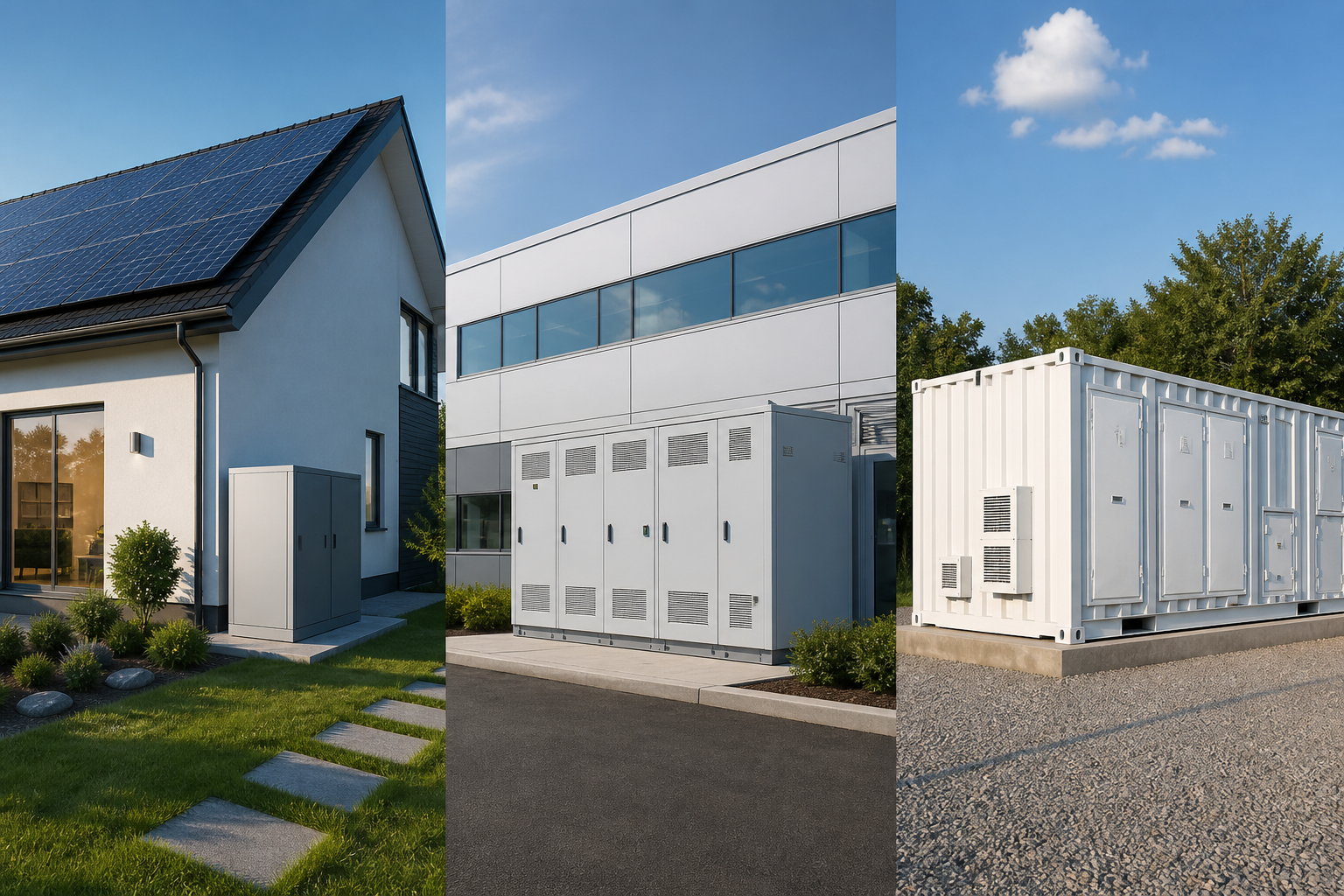





Solar + Storage integration station
Jiangsu 200 MW / 400 MWh
FLEET & SITE MANAGEMENT station and site management
From one site to the entire portfolio,
Keep Unified Run View
Station and site management organizes areas, sites, Blocks, cabinets, subsystems and equipment into the same set of asset classes so that operational status, anomalies, configuration versions, tasks and performance can be traced back from the assembly level to the equipment level.
The whole asset portfolio can be viewed and a reck, a set of PCS or a piece of equipment can be quickly drilled along the asset class.
Energy storage station in industrial park
Guangdong 50 MW / 100 MWh
Grid-side energy storage station
Mongolia 300 MW/600 MWh
Overview of asset portfolios (all regions)
Update to 2025-05-23 10:30
REG
Regional
9
SITE
Station
36
CAP
Total Capacity / Energy
6.58 GW / 13.16 GWh
AVL
Availability
97.42%
RATE
Indicators of anomalies
1.28%
ISSUE
Pending items
28
ENERGY
Cumulative operation
1.35 TWh
01 Summary of asset hierarchy and registration Harmonization of asset identity from area to equipment
Region
East China
Jiangsu/ Zhejiang/ Anhui
South China
Guangdong/ Guangxi
North China
Beijing/ Hebei
Northwest region
Shade / Gansu
Station
Jiangsu Salt City Sun One Station
200MW / 400MWh
Fushan Park Station, Guangdong
50MW / 100MWh
Inner Mongolia power grid side station
300MW / 600MWh
Block Block
Area A
50MW / 100MWh
Area B
50MW / 100MWh
Area C
50MW / 100MWh
Box / Rack
AC1-01
2.5MW / 5MWh
AC1-02 cabinet
2.5MW / 5MWh
AC1-03 cabinet
2.5MW / 5MWh
Subsystem
BMS
Battery management system
Rack
Batteries
PCS
Power Change
FSS
FIRE FIGHTING SYSTEM
HVAC
Thermal control system
Current asset path:
The East China Region, the Jiangsu Salt City Sun One Station, Area A, AC1-02
02 Station contrast board Comparison of performance across regions
Jiangsu. Station Running
Availability
98.76%
Current Power
126.5 MW
Cumulative Energy
238.7 MWh
Activity warning
3
Maintenance status
&Normal
Guangdong Foshan Park Station Maintenance
Availability
95.23%
Current Power
28.6 MW
Cumulative Energy
42.1 MWh
Activity warning
7
Maintenance status
Partial maintenance
Inner Mongolia Ulanchab power grid side station Running
Availability
97.88%
Current Power
201.3 MW
Cumulative Energy
412.8 MWh
Activity warning
2
Maintenance status
&Normal
Current view:
Jiangsu Salt City Sun One Station
03 Regional Operational Profile
In combination with the state of the observation posts, weather, regional alerts and the effects of transport.
04 Unusual event depth drilling We drilled all the way from the group level to the device and the subsystem.
Summary of events
Event Level
Important
Event Type
PCS power abnormal.
Event Time
2025-05-23 08:42
Impact object
BC2-07 / PCS
Current Status
Processing
Trends in key indicators
05 Site base Harmonized comparison of availability, efficiency, temperature control and power response
| Station | Availability | Energy density | Charge Efficiency | Heat management level | Power Response | Alarm density |
|---|---|---|---|---|---|---|
| Jiangsu Salt City Lighthouse Station | 98.76% | 2,145 | 91.32% | 28.6 | 1.45 | 0.32 |
| Guangdong Foshan Park Station | 95.23% | 1,678 | 89.11% | 31.4 | 1.92 | 0.81 |
| Inner Mongolia Ulanchab Station | 97.88% | 2,312 | 92.07% | 26.8 | 1.36 | 0.28 |
| Zhejiang Lakezhou Station | 97.29% | 2,045 | 90.83% | 28.9 | 1.58 | 0.47 |
Current baseline object:
Jiangsu Salt City Sun One StationI don't know. Comparison of availability, efficiency, heat management and alarm density of sites of the same size.
06 Station task force line Harmonization of inspection, inspection and configuration tasks
| Task Type | Task Title | Location | Planned time | Status | Head | Collaborators | Progress |
|---|---|---|---|---|---|---|---|
| Inspection | Monthly equipment inspections | Jiangsu Salt Station | 05-25 → 05-25 | Ongoing | Zhang | Maintenance team |
|
| Preventive Maintenance | PCS filters and dissipation | Fushan Station, Guangdong | 05-24 → 05-24 | Ongoing | Li Xiao. | Vendors |
|
| Configuration Check | Battery policy parameters verification | Inner Mongolia Station | 05-27 → 05-28 | Approved | Wang Man. | System Team |
|
| Change management | BMS software parameter optimization | Fushan Station, Guangdong | 05-26 → 05-26 | Under approval | Zhao | Transport team |
|
07 Configuration and baseline management
Harmonize the baseline, assess the impact of changes across sites and implement batch controlled releases.
:: Change of impact sites
• Consistency verification
• Approved
• Risk sites
08 Online process on site Standardized registration, verification and shipping
09 Station operations report One key to create management, anomalies, performance and maintenance view
Station operations report Reporting period: 2025-05-01 – 2025-05-23
Regional size
Area
9
Number of sites
36
Total capacity
6.58 GW
Availability
97.42%
Unusual events
An important alarm.
12
General alarm.
46
Event Clock Rate
92.3%
Asset completeness
Asset integrity rate
99.1%
Increase the completion rate
98.6%
Data completeness rate
99.2%
Responsibility and restructuring
Other Organiser
8
Overdue missions
3
Accountability recognition rate
96.7%
10 Boundaries and coordination Site view connects the asset platform, configuration governance and transportation processes
Asset management
Maintain unique asset identity and hierarchy across regions, sites, blocks, cabinets, subsystems, and devices.
- Asset ID and life cycle
- Levels and sprawl.
- Device Master Data
Configuration governance
Manage software, firmware, parameter, and protocol baselines; assess change impact and release in controlled batches.
- Version baseline
- Compatibility check
- Change and Roll Back
Transport process
The anomaly, inspection, maintenance and rehabilitation tasks are linked to the counterpart assets and those responsible.
- Worksheets and SLA
- Allocation of responsibilities
- Close & Operation Duplicate
Ultimate Principle:
Fleet management is not simply placing multiple site pages together, but establishing a unified
Asset Identity → Site Status → Incident → Benchmark → Work → Baseline → Report
Chains, which allow the combination-level state to eventually return to a clear physical asset and operational responsibility.